
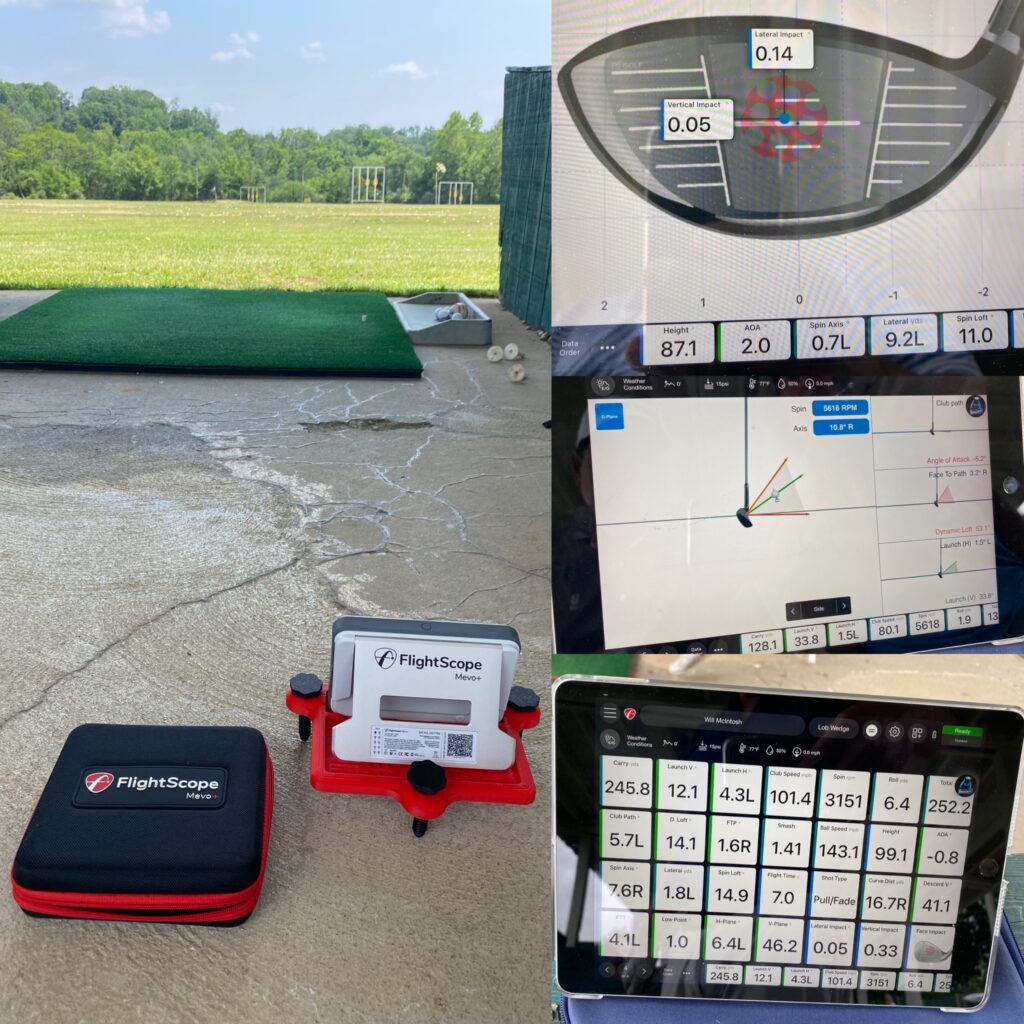
Golf has changed considerably in recent years, particularly in the technology available to coaches and players. In a game that has been played for hundreds of years, launch monitors, force plates, 3D motion capture, and other tools now provide access to information that would have been difficult—or impossible—to obtain in the past. But more technology doesn’t automatically lead to better golf. The real value comes from knowing what to measure, understanding what the data tells us, and translating that information into something a golfer can use to improve their swing and play better golf. That’s how I think about technology at McIntosh Golf.
It’s Not Just About the Numbers
Every golfer is different. Two players can hit very different shots for very different reasons, even when the results look similar. Sometimes, a golfer has an unusual movement pattern or produces data that doesn’t fit our expectations, yet manages to make it work remarkably well. And sometimes, what we think is happening in the golf swing isn’t what’s actually happening. Technology can help us look beyond appearances, but only when we understand what we’re seeing.
Launch monitors can measure ball speed, launch angle, spin, carry distance, and other important metrics. Video helps us examine movement and club delivery. Force plates and 3D motion capture can help us understand kinematics and kinetics. Combined with an understanding of a golfer’s physical capabilities, these tools can give us a clearer picture of what’s happening and help identify where improvement is most likely to come from. But merely collecting data isn’t the objective. Understanding the golfer is. A number only becomes useful when we understand what it means, why it matters, and what, if anything, we should do differently because of it.
The Right Information for the Right Golfer
Used appropriately, technology can help golfers at every level. It’s not just for elite or competitive players. For beginners, seeing actual carry distances or club speed can help build an understanding of how far each club travels and provide tangible evidence of progress. Video or simple measurements can make an unfamiliar movement easier to understand, while seeing improvement in the numbers can be a powerful confidence builder.
For intermediate golfers, technology can help us investigate inconsistent contact, unpredictable ball flight, or gaps between clubs. Rather than guessing at the cause, we can gather evidence, test an adjustment, and evaluate whether it produces the intended result. Of course, golf isn’t a exactly a perfectly controlled laboratory. Conditions change, and golfers don’t produce identical swings or shots every time. The data is useful, but it doesn’t tell the entire story.
For competitive players, more detailed measurements may help refine shot patterns, optimize launch conditions, manage trajectory and spin, and develop more reliable performance under pressure. The tools and level of detail may differ, but the principle remains the same: use the information that helps answer the question in front of us. A good coach also knows when more information won’t help—and when it might actually make things harder. Some players respond well to detailed measurements and technical explanations; others learn more effectively through images, simple cues, or feel. The technology may provide the same information, but how it’s received, interpreted, and applied depends on the individual. That human element is essential: both the coach and the player must make sense of the information and determine what to do with it.
Connecting the Data to Feel
Golf isn’t played by looking at numbers on a screen. It’s played by a person who has to move, sense, react, make decisions, and deliver the club to the ball. That’s why my approach combines what we can measure with what a golfer can feel, understand, and learn to recognize.
We might use technology to identify a pattern, then work through drills or adjustments to understand how to change it. We pay attention to the movement, the quality of contact, the resulting ball flight, and the golfer’s awareness of what works. Over time, the goal is to develop an understanding of the key feels and concepts that help produce better shots—and the ability to reproduce them.
This is also where my background with the Titleist Performance Institute (TPI) informs my coaching. My Level 3 certifications in Golf and Power have deepened my understanding of the relationship between a golfer’s physical capabilities, movement, and swing. Not every golfer needs the same movement pattern or the same solution. The goal isn’t to force everyone into one model, but to understand the individual, recognize the relevant constraints, and develop an approach that works for that person. Technology can help us see more clearly; coaching helps us determine what matters and how to use that information.
From Measurement to Improvement
One of the biggest mistakes we can make is confusing measurement as being 1:1 with learning or development. A golfer might produce a better number during a lesson but struggle to reproduce the result the following week. Another might make a meaningful improvement in contact or consistency without every metric changing dramatically. That’s why I view technology as part of a larger feedback and learning process. We observe what’s happening, identify a priority, make an adjustment, and evaluate the result. We refine our understanding and continue developing the skill.
Ultimately, we want to know whether the improvement holds up beyond the practice tee—on the golf course, where decisions matter, conditions change, and the golfer must rely on their own abilities. The real objective is to develop the player’s skill, understanding, and ability to make adjustments independently on the golf course.
The Technology Should Serve You
I’m excited by what modern golf technology makes possible, and I expect to continue incorporating it into my coaching wherever it adds meaningful value. However, I don’t believe a better lesson is simply one with more data, more screens, or more equipment. However, sometimes the customer may have that notion.
A better lesson is one that helps us understand the golfer more clearly, identify what matters most, and make progress the golfer can recognize, understand, and eventually reproduce on the course. By all means, sometimes that means a detailed look at the numbers; however, sometimes it means a simple drill, a different feel, a clearer concept, or a new and better task. Part of the art of good coaching is knowing the difference.
At McIntosh Golf, my goal is to combine the benefits of modern technology with individualized coaching, practical learning, and a focus on what ultimately matters: helping you develop your skills, play better golf, and enjoy the process. Technology can tell us a lot about a golf shot. The real value lies in knowing what to do with what it tells us.
Ready to take a more informed approach to your game? Explore golf coaching and player development at mcintosh.golf.